Why is it wrong to kill people
Bullet TrainWhy is it wrong to kill people? is the Prince’s favourite recurring question and a test he uses to probe the limits of adult explanations. The exchange does not settle into a single ethical argument: Tangerine answers with literary transgression, Suzuki offers personal grief and then questions why the Prince singles out murder, and Kimura later turns the question back on its asker as evidence of the Prince’s misplaced certainty. Across these encounters, the expression exposes both a genuine disagreement about moral reasoning and the failure of conversation to bridge it.
A Question That Returns
The Prince’s question is not presented as a passing curiosity. In his conversation with Tangerine, it is identified as his favourite; later, the narration calls it the question he asks “as always.” Its recurrence gives it a recognizable place in his exchanges with adults. The question shocks them, and, as the narration observes, they try to brush it aside with platitudes without answering it. The gap between the starkness of the question and the evasiveness of the responses becomes part of its force: it asks for a reason that will hold beyond convention, but the conversations repeatedly supply answers grounded in personal feeling, familiar rules, or literary display.
The repeated wording also makes the question a test that can be applied to different kinds of answer. The Prince is not satisfied merely because another person objects to killing. He asks what makes that objection persuasive, especially to someone who does not share the same feelings. In this way, the expression is less a request for a slogan than a demand to examine the foundations of a prohibition. The scenes do not establish that the Prince has solved that problem; instead, they show him pressing adults to explain why the rule should bind anyone who does not already accept its moral premise.
Tangerine’s Literary Reply
When the Prince poses the question to Tangerine, Tangerine answers by invoking Dostoevsky’s Demons. He presents the novel’s treatment of crime as suggesting that transgression can seem like common sense, and even a form of protest. Tangerine says that this account matches his own view. His response therefore meets the question with a literary argument that unsettles the idea that wrongdoing is always self-evidently irrational or abnormal.
The Prince is not persuaded that Tangerine has answered him. He agrees with part of the claim about crime’s apparent rationality, but regards the suggestion that crime constitutes a gallant protest as narcissistic and, at most, superficially amusing. The distinction matters: the Prince can accept a description of how someone might rationalize crime while rejecting that description as a justification. Tangerine’s reference to a novel supplies language for transgression, but, in the Prince’s judgment, it does not resolve the underlying question. His disappointment continues the pattern of the expression: an answer may sound learned or provocative and still fail to address what he wants to know.
Suzuki’s Personal Answer and Challenge
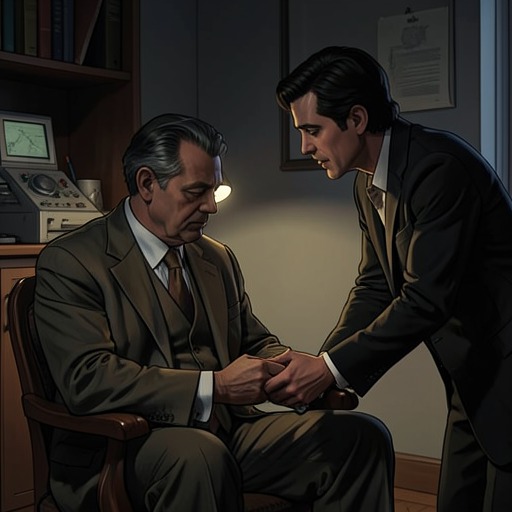
Suzuki responds from personal feeling. He explains that being killed, or being attacked even without being killed, is heartbreaking and sad, and that he would rather such things never happened. The Prince claims to understand and share this feeling, but the narration makes clear that this agreement is a lie. He distinguishes Suzuki’s personal objection from the more general reason he seeks: if someone did not feel that way, would that person have no reason to refrain from murder? He also points to war and the death penalty, which adults accept despite their professed objection to killing. His challenge is not answered simply by repeating that death is sad; he is asking how a moral rule can be defended amid exceptions adults already permit.
Suzuki acknowledges that his answer is personal and says that, for him, people should never kill under any circumstances because dying is the saddest thing there is. Rather than pretend that this is the kind of reasoning the Prince wants, he asks him a question of his own. The exchange shifts from the substance of the prohibition to the Prince’s fixation on it. Suzuki observes that life is crowded with rules, including prohibitions on punching people, entering someone’s home to sleep, making a campfire in the school playground, and insulting others. He wonders why the Prince singles out the rule against killing and suggests that children who ask this question may be taking an issue to an extreme in order to unsettle adults. The Prince rejects that interpretation and insists that he really does want to know.
The Question Reversed
The final use of the expression changes its target. At Morioka, Kimura tells the Prince that he will not answer his questions. He identifies information the Prince lacks: who Kimura has just spoken to, and that Wataru is safe and awake. Kimura then connects the Prince’s recurring question to the Prince’s apparent conviction that he understands everything and can look down on adults as fools. Rather than debate the morality of killing, Kimura uses the question to challenge the Prince’s confidence in his own knowledge.
That confrontation does not provide a new answer to the question. Instead, it reveals the question’s dramatic vulnerability: a demand that adults explain what they believe can also expose the asker’s assumptions and blind spots. Kimura refuses to give the Prince further information, leaving him in the dark about facts central to the immediate situation. The expression thus recurs as a verbal challenge, but its significance changes. What once seemed to place adults on trial becomes part of Kimura’s rebuke to a boy who has mistaken intelligence for complete understanding.